Collaborative robots
Cobot arms work directly alongside your crew on assembly, gluing and precision handling — force-limited and safety-rated for shared workspace.
Ground & marine fleet
From Ex-certified inspection robots walking petrochemical plants to subsea platforms rated for 10,000 m, Orion's industrial fleet takes over the loops that put people at risk.
Platform types
Cobots, humanoids, mobile robots and machine vision — every platform we deploy reports into the same Joint Inspection Center, so your team supervises one fleet, not four.
Cobot arms work directly alongside your crew on assembly, gluing and precision handling — force-limited and safety-rated for shared workspace.
Bipedal platforms handle tasks built for human-scale tools and access points — stairs, ladders, valves and controls designed for people.
Self-navigating AMRs move parts, pallets and materials across a site without fixed rails — routing themselves around people and obstacles.
Vision models trained for bin-picking, defect detection and canopy mapping give every platform the eyes to work without a fixed script.
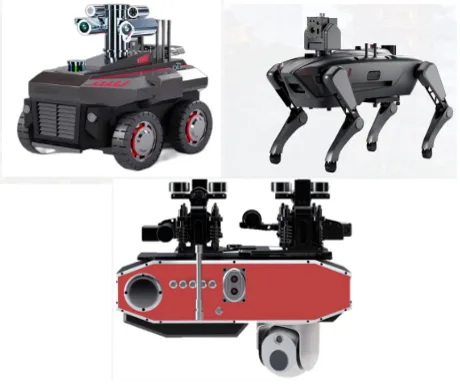
Explosion-proof ground suite
Ex-certified quadruped and wheeled (L4-S Class) platforms replace manual inspection loops in explosive gas environments — petrochemical plants, refineries and power grids.
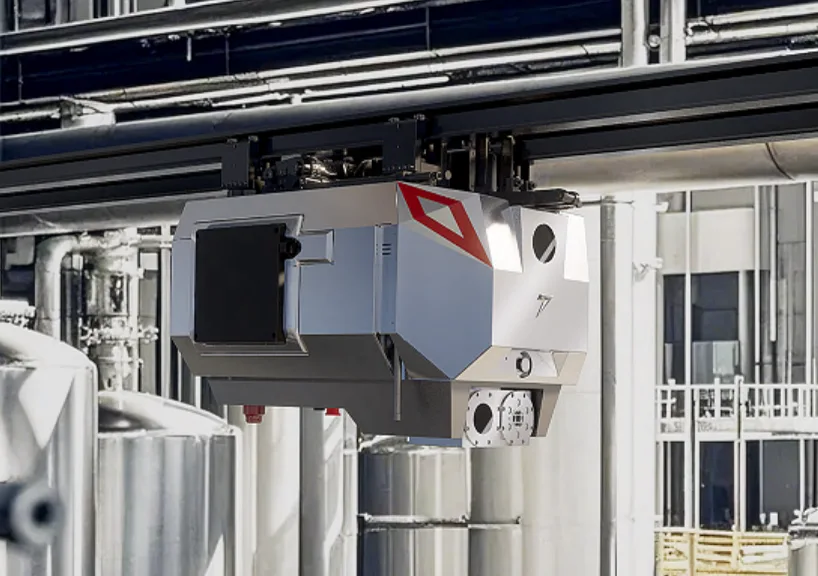
Overhead surveillance
Overhead rail robots patrol transformer banks and switchyards on a fixed track — out of the way, out of danger, and never off shift.
Marine systems
Surface and subsea robots engineered for a 10,000-hour service life — built on six core systems that keep working where the ocean pushes back.
Drivetrain engineering that delivers 3x speed and 25x component lifespan compared with conventional subsea propulsion.
Station-keeping and manoeuvring that holds steady in 3-knot currents, so missions finish in the conditions they started in.
Twice the clarity and range in murky water, turning zero-visibility inspections into usable engineering data.
Precise positioning relative to hulls, structures and moving vessels — not just a point on a chart.
Sealing systems proven to 10,000 m keep electronics dry from harbour depth to full-ocean trench.
Launch and recovery streamlined to one-tenth the setup time, so the robot is working while others are still rigging.
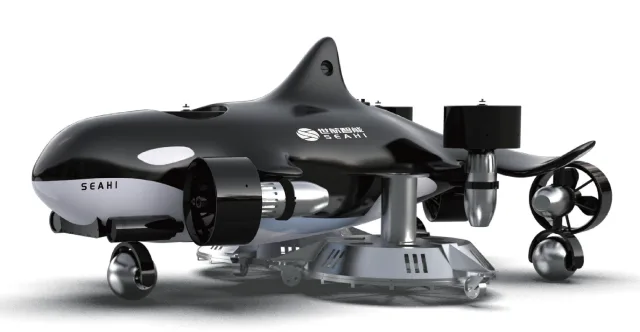
Biofouling elimination
Hull-cleaning robots with 720° movement work vessels from 100 to 300,000+ tons — restoring smooth hulls without dry-docking the ship.
Walk us through your inspection loops and we'll show you which ones a robot should be doing by next quarter.